Weeping Tiles and Foundation Health in London, Ontario: Myths and Facts
Walk around a London bungalow from the 1960s and you can almost hear the story beneath your feet. Clay-rich soil presses against concrete walls, a seasonal water table rises with spring melt, and somewhere below the frost line a perforated pipe, the weeping tile, is supposed to shuttle water away before it becomes a problem. When it works, you never notice it. When it fails, you notice everything.
I have spent a good part of two decades looking at basements in Old South, White Hills, and the newer subdivisions near the 401. The same questions come up again and again. Do I need to replace my weeping tiles? Will a French drain in the yard help? Are the stains on my basement walls a cosmetic nuisance or a symptom? The right answer depends on local conditions as much as it does on best practice. London is not Windsor, and it is not Sudbury. Our clay till behaves in its own way, and the Thames River valley gives us predictable wet seasons that punish mistakes in drainage.
This is a plainspoken guide to what really matters for foundation health here, with the myths, the trade-offs, and the details that make one house dry while another, on the same street, stays damp.
What a weeping tile does, and what it does not do
A weeping tile is a perforated pipe installed at the base of the foundation, typically at or just below footing level. It is wrapped in filter fabric or surrounded in washed stone to keep soil out, and it drains to a safe point: a sump pit with a pump, a storm sewer connection where permitted, or daylight if the lot allows a proper slope. In older London houses it might be actual clay tile, hence the name. By the 1980s most builders had moved to corrugated plastic, and many modern installations use rigid PVC with holes facing down.
A footing drain is not a waterproofing membrane, and it cannot overcome https://claytonumug751.iamarrows.com/basement-waterproofing-london-ontario-drainage-sump-pumps-and-more-1 a wall that lets bulk water in because of cracks or porous block. Its job is to relieve hydrostatic pressure at the base of the wall. Think of it as the exit door for water that has already reached your foundation. If the exit is clogged, too high, improperly sloped, or has nowhere safe to go, pressure builds and water looks for easier paths, often through mortar joints or floor-wall seams.
I have scoped more than one weeping tile that ended abruptly at a buried stump or a pile of concrete tossed in the trench 50 years ago. It still “existed,” but it never had a fair chance to work.
Soil, water, and the London picture
Soil is destiny in drainage. Across much of London, especially north of Commissioners and west of Highbury, you find dense clay till with low permeability. Water does not percolate far in saturated conditions. After a thaw or a multi-day rain event, that means the soil around your foundation behaves like a saturated sponge. London typically sees on the order of 900 to 1,000 millimetres of precipitation in a year, with meaningful spring and fall peaks. That pattern explains why many homeowners report a dry basement all summer and a damp line on the wall the week after the first big melt.
Two other local factors matter:
-
The frost depth. Foundations here are usually below 1.2 metres. That keeps frost from getting under the footing, but it also means the weeping tile lives in soil that cycles through freeze-thaw, which can shift fines and silt into perforations if the filter layer is skimpy.
-
The lot. Subdivisions built on gentle fill may have flat backyards with little surface fall. In those places, backyard drainage in London, Ontario often needs help from swales, regrading, or properly designed French drains, because there is no natural path to daylight.
How the system is supposed to be built
On a sound installation, you see a clear sequence when you open a trench:
- A clean, compacted base at footing level that slopes gently toward the discharge point, typically 1 percent or better.
- A continuous run of perforated pipe with perforations down, surrounded by 19 mm washed stone, or similar, to a depth of at least 150 mm above the pipe.
- A non-woven filter fabric wrapping the stone to keep fines out.
- A waterproofing layer on the wall, not just damp-proof tar. Modern wraps or membranes stop liquid water and bridge small cracks.
- At least one cleanout brought to grade, so you can flush the system without digging.
- Positive drainage away from the foundation at finished grade, which depends on your landscaping more than your builder.
When one of those layers is missing, the rest is forced to cover for it. Corrugated pipe with the holes up will act like a gutter and collect fines. Washed stone without fabric can work for a while, then slowly silts up. No cleanout guarantees you will eventually guess what is wrong rather than test it.
Myths that need to die, and the facts I see on site
-
Myth: My weeping tiles failed because the pipe collapsed. Fact: True pipe collapses are rare. What I usually find is clogging by fines or roots at joints, or a discharge line that was flattened during backfill. Corrugated plastic can deform under poor backfill, but it remains open more often than you think.
-
Myth: Power washing from a basement floor drain will clear the weeping tile. Fact: A floor drain is usually tied to sanitary or a separate line, not the footing drain. Even where there is a connection, flushing from the wrong end packs silt into perforations. Use exterior cleanouts and a jet from the low point out toward the discharge.
-
Myth: A French drain anywhere in the yard fixes a wet basement. Fact: A French drain handles surface or shallow subsurface water in a defined area. It is useful for backyard drainage in London, Ontario where hardpan and flat lots hold water, but it does not relieve hydrostatic pressure at the footing unless it ties into a proper discharge at footing depth.
-
Myth: A socked pipe is always better. Fact: Socks can help in sandy or silty soils. In our heavy clays, the fabric on the surrounding stone is more important. A sock can clog like a filter in a smoker’s car, and you are not going to change it.
-
Myth: Downspouts buried into the ground are an upgrade. Fact: Bury a downspout incorrectly and you pipe roof water straight to your foundation. Above-grade extensions that carry water 2 to 3 metres out perform better than most ad hoc underground tie-ins.
Diagnosing trouble without tearing up the yard
You do not need to excavate first to figure out if your weeping tile might be the culprit. A simple sequence will tell you where to look.
-
Track timing. Moisture that appears 24 to 48 hours after heavy rain or spring melt points to groundwater pressure. A puddle during rain suggests surface water entry, often from grading or window wells.
-
Inspect discharge. If you have a sump, watch it during wet weather. Frequent cycling with clear water means the drain is moving water. Silence when the yard is saturated is a red flag.
-
Look for horizontal patterns. A wet line at a consistent elevation on the wall typically sits near the footing. Random vertical streaks near windows are often separate issues.
-
Camera where possible. Many weeping tiles in London, Ontario now have cleanouts. A quick camera probe finds breaks, sags, or blockages without guesswork.
-
Test with a hose, carefully. Feeding a moderate flow to a trench away from the wall and observing the pit or discharge can demonstrate whether water reaches the system, but do not flood a window well or the wall itself.
French drains, yard grading, and what really helps outside the wall
When people search for french drains London Ontario, they are usually standing in a lawn with wet footprints in June. The problem in that moment is not the footing drain at all. It is how the yard handles water that falls or flows across the surface.
A French drain is a trench with perforated pipe, gravel, and fabric, designed to intercept and redirect shallow flows. It lives at 0.3 to 0.6 metres, not at footing depth. In clay soils, it is most effective when it has a guaranteed path to daylight or a dry well sized generously, because infiltration is slow. Tie a French drain into a sump without careful separation and you invite the yard to send every storm into your basement pump, which shortens the pump’s life and can overload it during big storms.
The simpler fix is often grading. I have seen more persistent basement dampness cured with a weekend’s worth of fill and sod than with any pipe. You want a fall of 5 to 10 centimetres over the first two metres away from the house. That is not much. A long level and a string line will show you what you have. Rebuild settled soil under decks, extend downspouts, and clear swales between lots so they carry water to the street. These are not glamorous jobs, but they are effective.
Exterior replacement versus interior drains
When weeping tiles fail outright or never existed, you face a choice. Do you excavate and rebuild from the outside, or do you install an interior perimeter drain with a wall membrane to channel water to a sump?
Exterior replacement solves the root cause at the right elevation. You lower water pressure at the footing and you gain the chance to waterproof the wall, replace window well drains, and add insulation if you wish. It is disruptive. Expect to remove shrubs, sometimes porches or stairs, and you will need space for a mini-excavator and spoils. On a typical London bungalow with 40 to 60 linear metres of wall, exterior excavation and full system replacement often lands in the CAD 12,000 to 25,000 range, higher if access is tight, concrete is thick, or you add features like rigid insulation, drainage mats, and new window wells.
Interior systems avoid exterior disruption and can be installed year-round. A contractor cuts a trench at the slab edge, installs a perforated pipe in stone, and then adds a dimpled membrane on the wall to guide seepage down into the drain and toward a sump. That approach manages water effectively in many cases, and it is less expensive, commonly CAD 60 to 120 per linear foot inside, depending on scope. It does not reduce exterior hydrostatic pressure. Your wall remains on the wet side, but the water is controlled. For poured concrete with hairline cracks and a dry corner sump, this can be a clean solution. For block foundations with bulging walls or heavy exterior pressure, I prefer exterior work if access and budget make it feasible.
Some homes end up with a hybrid: an exterior repair on the worst wall and interior management elsewhere. Purists frown at that, but it fits the reality of budgets and landscaping.
Materials that last in our soil
On the ground, choices about pipe and stone matter. Rigid PVC SDR35 or equivalent with holes down keeps grade and resists deformation better than corrugated. In curved runs or where cleanouts need to turn, long sweeps beat sharp elbows. Around the pipe, I want washed stone with enough depth above and below to create a reservoir, and a non-woven fabric wrapped around the stone, not just tossed on top. The fabric’s job is to keep fines out of the stone, not to wrap the pipe like a Christmas present.
I like to bring at least two cleanouts to grade, one at the high point and one near the discharge. A cap flush with a mulch bed is not a blemish. It is a future day saved. On the discharge side, if you connect to a storm lateral, confirm with the city or your plumber that you are not illegally tied to sanitary. London’s older neighborhoods contain surprises. If you discharge to a sump, a sealed lid, a reliable pump with a separate circuit, and a battery backup are not luxuries. They are your insurance against a storm-night failure when the power flickers.
Window wells, stairwells, and little traps
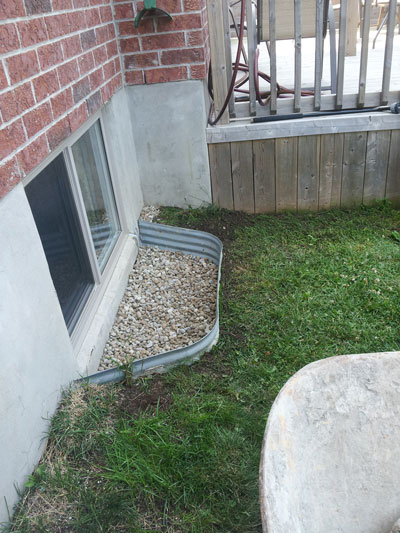
If your lot sits low, window wells collect water like small ponds. A well needs a drain at the bottom that ties into the weeping tile or a dry well, and it needs clean stone inside to let water move. Covers help, but a cover on a blocked well only hides the water. The same goes for basement stairwells. I have seen two stairwells in Old North drain to a 2-inch pipe that ran nowhere. A 15-minute hose test in the well made the problem obvious.
Where code requires egress windows, especially for basement apartments, retrofits deepen wells and sometimes cut foundation openings lower than the original grade. That makes drainage detail more important, not less.
Maintenance that is worth the effort
A footing drain is not a forever item that never needs attention. In a best-case installation, you can forget about it for years, then give it a little help.
- Every couple of years, check that downspouts still discharge far from the wall and that grade has not settled. Soil always moves next to foundations, especially after work.
- After major landscaping or concrete work, verify that cleanouts are visible and undamaged, and that heavy equipment has not crushed a discharge line.
- Jet and camera the line if you notice slow sump response or a wet band on the wall. In my experience, light silt and iron slime migrate into sumps, and a quick flush restores flow.
- If you have trees near the foundation, especially willows or silver maples, root intrusion is real. A yearly camera pass can prevent a bigger problem later.
Municipal connections also change. Where older homes once drained to storm lines, some now require separation. Before you replace anything, a call to the city or a licensed plumber who knows local by-laws avoids tearing up new work later.
Costs, schedules, and the best time to act
People ask if spring pricing is higher. What I have seen is not price, but backlog. After a wet April, drainage contractors in London, Ontario can be booked for six to twelve weeks. If you know your system is suspect, get on the list in late winter. Fall is good for exterior work because soils are drier and landscaping can be restored before winter, but I have excavated in January with ground heaters and blankets when a home needed it. You pay a premium for frozen ground, and lawns never enjoy it.
For budgeting, exterior footing drain replacement with modern membranes, cleanouts, and stone usually falls into that CAD 12,000 to 25,000 bandwidth for a typical home, but tight access, concrete patios, and deep foundations push it higher. French drains in a backyard, built right with fabric and stone, commonly run CAD 80 to 150 per linear foot, depending on depth and whether there is a reliable daylight outlet. Interior perimeter drains vary with slab thickness and obstructions, but the CAD 60 to 120 per linear foot range captures most projects I see. Sump upgrades, with a sealed basin, quality pump, check valve, and backup, often land between CAD 1,200 and 3,000.

Any quote without a site visit is a guess. Soil, access, and existing tie-ins always change the picture.
Picking the right help, and what good contractors do differently
I keep a short list of drainage contractors in London, Ontario who show up with the right tools and habits. The difference is not a secret, but you can spot it early if you know what to ask.
Good contractors probe for the path of water before they pick up a shovel. They camera lines when cleanouts exist, dig a test pit at a corner to confirm footing depth and wall condition, and mark utilities properly. They bring washed stone, not whatever was on sale at the quarry, and they wrap the drain field with fabric. They slope the pipe to a discharge you can explain to your neighbor, and they put that explanation in writing.
Less careful crews use native soil backfill around the pipe, skip fabric, tie downspouts into the same trench without air gaps, and disappear before you see how the sump cycles in a storm. If the site visit takes five minutes and the quote is a single number, ask for details or keep looking.
A case from Old South
A 1948 brick bungalow on a quiet street near Wortley had a wet line on two walls and a musty smell, but the homeowner swore the sump ran fine. The downspouts ended with those little flip-up elbows right next to the wall. The backyard was nearly flat, and a neighbor’s yard drained toward theirs along a fence line.
We scoped the weeping tile from an old cleanout and found two things. First, the tile along the back wall was intact, but full of fines where a deck post had been installed right through the stone field. Second, the discharge line to the sump was sloped backward for the first three metres. The pump could not draw water efficiently from the far run, so the tile acted like a stagnant hose.
We replaced roughly 12 metres of exterior tile along the back, restored slope to the discharge, and installed a shallow French drain along the shared fence with a daylight outlet to the front swale, which the city already maintained. We extended downspouts with 3-metre leaders and added two wheel-friendly ramps over them for lawn mowing. Cost was roughly CAD 9,500, mostly because we limited excavation to the worst wall. The homeowner held off on washing the interior walls so we could monitor. After the spring melt, the sump cycled steadily, the wet line faded, and the odor vanished without interior work. The deck posts were reset on helical piles clear of the drain field. That small detail probably saved future trouble.
DIY or hire it out
Plenty of homeowners in London handle surface fixes. Regrading with a few yards of clay fill, adding sod, extending downspouts, and even installing a small French drain that daylight drains to a ditch are within reach for careful DIYers. The risks start when you trench near a foundation, tie into underground services, or rely on a sump connection without checking your municipal setup. A poorly done underground downspout tie-in is a classic own goal. It hides the problem until a big storm turns your basement into an indoor pool.
Excavating to the footing level, membrane work, and tying a footing drain to a storm lateral or sump should be left to people who have cameras, locates, proper compaction equipment, and insurance. A well-intended neighbor with a mini-excavator can move earth quickly, and also quickly create a bigger bill.
Where French drains fit alongside footing drains
The phrase french drains London Ontario is used online to cover everything from perforated hoses in trenches to robust subsurface systems. In a backyard with seasonal ponding because of clay and a flat lot, a real French drain, 30 to 45 cm below grade, wrapped in fabric and filled with washed stone, can keep lawns usable and stop water from creeping toward the house. It pairs well with simple grading tweaks and proper downspout extensions. It does not replace a weeping tile. The two systems live at different depths and do different jobs. When designed together, they keep both surface and subsurface water moving the right way, away from your walls and footings.
If you are contacting drainage contractors in London, Ontario, be clear about your goals. If the basement leaks at the floor-wall joint, talk footing drains and sump performance. If the yard is a marsh and the basement is dry, talk grading and French drains. Mixing the two conversations usually produces half measures.
The line between myth and maintenance
Weeping tiles have a mystique because they are buried and out of sight. They are not magical. In London’s soil, a simple, well-built footing drain paired with good grading and disciplined roof water control keeps most basements dry for decades. The myths persist because quick fixes are tempting and water is patient.
If your home is older and you are not sure what was installed, find or add a cleanout and camera the system once. Confirm where the water goes. Take an hour with a level and a string line around the house. Watch the sump during a spring melt. These small acts of inspection cost little and point you toward the right remedy. And when you do need help, hire for method, not marketing. The contractors who slow down at the start are the ones who finish with a foundation that breathes easy, no drama the next time the Thames swells and the clay soil tries to make your basement part of the river.
Ashworth Drainage — Business Info (NAP)
Name: Ashworth DrainageAddress: 514 Hale St, London, ON N5W 1G8
Phone: (519) 660-9375
Website: https://www.ashworthdrainage.ca/
Email: [email protected]
Hours:
Monday: 9:00 AM – 5:00 PM
Tuesday: 9:00 AM – 5:00 PM
Wednesday: 9:00 AM – 5:00 PM
Thursday: 9:00 AM – 5:00 PM
Friday: 9:00 AM – 5:00 PM
Saturday: Closed
Sunday: Closed
Open-location code (Plus Code): XRR3+HV London, Ontario
Map/listing URL: https://maps.app.goo.gl/9kaoXAxRtJRP1ThS9
Embed iframe:
Socials (canonical https URLs):
Facebook: https://www.facebook.com/ashworthdrainage/
X: https://twitter.com/ashworthrules
Instagram: https://www.instagram.com/ashworthdrainage/
https://www.ashworthdrainage.ca/
Ashworth Drainage provides basement waterproofing and foundation repair services in London, Ontario and surrounding areas in Southwestern Ontario.
The company helps homeowners address wet basements, water intrusion, and drainage issues with solutions that fit the property’s conditions.
Service requests can include foundation repair, waterproofing options, sump pump and drainage-related work, and related assessments.
Ashworth Drainage is based at 514 Hale St, London, ON N5W 1G8.
To reach the team, call (519) 660-9375 or email [email protected].
Business hours are Monday to Friday 9:00 AM–5:00 PM, with the office closed Saturday and Sunday.
For directions and listing details, use the map listing: https://maps.app.goo.gl/9kaoXAxRtJRP1ThS9.
Popular Questions About Ashworth Drainage
What does basement waterproofing help prevent?Basement waterproofing is intended to reduce water intrusion and moisture problems that can lead to dampness, leaks, odors, and damage over time.
How do I know if I may need foundation repair?
Common signs can include visible cracks, water seepage, shifting or uneven areas, or recurring moisture problems; an on-site assessment is usually the best way to confirm causes and options.
What areas does Ashworth Drainage serve?
Ashworth Drainage serves London, Ontario and surrounding areas in Southwestern Ontario.
What are Ashworth Drainage’s hours?
Monday–Friday 9:00 AM–5:00 PM; Saturday closed; Sunday closed.
How can I contact Ashworth Drainage?
Phone: +1-519-660-9375
Email: [email protected]
Website: https://www.ashworthdrainage.ca/
Map: https://maps.app.goo.gl/9kaoXAxRtJRP1ThS9
Facebook: https://www.facebook.com/ashworthdrainage/
X: https://twitter.com/ashworthrules
Instagram: https://www.instagram.com/ashworthdrainage/
Landmarks Near London, ON
1) Kiwanis Park2) Western Fair District
3) Covent Garden Market
4) Victoria Park
5) Budweiser Gardens
6) Museum London
7) Fanshawe Conservation Area