How to Improve Clay Soil Drainage in London, Ontario with French Drains
London sits on a stubborn mix of silty clay and clay loam that holds water like a sponge. After a rain, many backyards gleam with standing puddles long after the forecast clears. In spring, freeze-thaw cycles turn lawns into rutted soup. In summer, the same clay bakes into brick. If you live here, you already know the pattern, and you have probably tried aeration, topdressing, or rerouting downspouts. Those help, but when water has nowhere to go, you need a path out. That is where a well designed French drain foundation repair cost london on earns its keep.
I have pulled more than a few pairs of rubber boots out of London clay. Some installs go smoothly, others fight you for every trench length. The difference is rarely the product. It is the plan, the soil handling, and the details of discharge. This guide pulls together what works locally, what trips homeowners up, and how to judge when you should bring in a professional.
Why clay in London behaves the way it does
Clay soil drains poorly because the particles are tiny and pack tightly, which limits pore space and slows infiltration. In London, glacial till left us with a high percentage of fines, usually over 40 percent clay by lab tests, with permeability as low as 10^-6 m/s. That is a number engineers use, but your yard tells the story. You step, the ground squishes, the water creeps. When the frost line settles in around 1.2 to 1.5 metres, shallow frost lenses form in wet clay and push on structures. In late winter, when that lens melts, water has an even harder time moving through the semi-frozen matrix.
Compaction compounds it. Newer subdivisions in North and West London often have fill soils compacted by heavy equipment. The top 15 to 30 centimetres might accept some rain, but below that is a dense pan. You cannot fix that with topsoil alone. Water perched on that pan will migrate sideways, hunting the lowest grade, which might be your patio base, the north side of the house, or your neighbour’s fence line.
What a French drain actually does
A French drain is a subsurface trench filled with clean, angular stone that surrounds a perforated pipe, all wrapped in a geotextile that lets water in and keeps fines out. Water prefers the path of least resistance. The trench becomes a low resistance channel that collects shallow groundwater and surface infiltration, then carries it to a safe discharge point.
French drains are not the same as foundation weeping tiles. When people search for weeping tiles London Ontario, they are usually thinking of the perforated pipe that sits along the outside footings or inside the basement slab and ties into a sump. Those protect the foundation. A yard French drain, placed in the turf or garden at a depth of 30 to 60 centimetres, protects the landscape and keeps water away from structures. The materials look similar, but the rules for placement and outlets differ.
When a French drain is the right tool
If your downspouts dump at the foundation, fix that first. Extend them at least 2 to 3 metres away, ideally to a splash area on a downhill grade. If that does not solve the problem, think about patterns. Do you have a lawn basin with only one low exit? A swale that flattens into a dead end? A patio edge where water constantly puddles? Those are classic use cases for a French drain. In clay, over-seeding with deep-rooted grasses or adding a few centimetres of compost makes a small dent. To move real volumes, you need a pipe.
Homes with short front setbacks, common in newer London neighbourhoods, often have nowhere to surface drain. There, a French drain that leads to a curb cut, storm lead, or dry well can be the difference between a firm lawn and chronic mud. If you are searching for backyard drainage London Ontario because half your yard turns marshy after a storm, a French drain placed along the downslope edge of the problem area often becomes the relief valve that pulls the whole space back into balance.
Planning for London conditions
Water management has to respect the rules of slope, frost, and discharge. In our clay, aim for at least 1 percent fall along the pipe, preferably 1.5 percent if space allows. That is 1 to 1.5 centimetres of drop per metre of run. Over 20 metres, you want 20 to 30 centimetres of fall. You will not always have that, but fight for slope wherever you can.
Depth matters, but deeper is not always better. In clay, the effective collection zone for a backyard French drain is usually 20 to 60 centimetres below grade. Go deeper and you risk entering the unyielding compacted layer where trenching becomes miserable and the drain collects less. In freezing conditions, pipes at 30 to 40 centimetres of cover will not flow for a day or two after a deep cold snap, but they resume as soon as thaw starts. If your outlet is above frost or exposed, freezing is a concern. Bury outlets or use a sump discharge below frost where possible.
Where does the water go? This is the point that decides whether a project succeeds. Some older London streets have rear yard catch basins that tie into municipal storm. Many do not. Without a legal storm connection, good options include:
- A daylit outlet on a downhill bank, stabilized with stone to prevent erosion.
- A curb cut to the street, only if your municipality allows it and the grade supports flow.
- A dry well built large enough to accept a storm surge and then slowly bleed into subsoil. In clay, that means bigger than you think. A typical 1 cubic metre pit in clay can take hours to empty, so most homes need 2 to 4 cubic metres or a series of linked pits.
If none of those exist, use a pumped solution. An exterior sump basin, connected to the French drain and discharged through solid pipe to a downhill area or to the front curb, is common in tight lots. Many drainage contractors London Ontario rely on this setup when gravity will not cooperate.
Materials that hold up in clay
Perforated pipe choice is not glamorous, but it matters. Corrugated black HDPE is flexible and easy to lay, which helps on sinuous paths. It is also prone to sags if backfill is not perfect. Rigid PVC SDR35 or triple-wall pipe holds grade better and resists crush under vehicle loads. For lawns and gardens with gentle curves, I often choose rigid pipe with sweep fittings and take the time to bed it in stone. If we are threading between tree roots or around utilities, corrugated speeds the job.
Use pipe with slotted perforations, not round holes, wrapped with a factory sock only if the trench lacks fabric. In most London clay installs, I prefer a trench-wide nonwoven geotextile, 100 to 150 grams per square metre. It is strong enough to resist punctures from stone, but permeable enough to pass water freely. Wrap the entire stone envelope, not just the pipe. That keeps the trench from filling with silt over time.
Stone size drives flow. Clean, angular 19 mm clear stone is the standard. Pea gravel rounds off and packs tighter, which reduces flow. Do not use any product with fines. You want the space between stones to be air, then water. For base thickness, I like at least 10 centimetres of stone below the pipe and 15 to 20 centimetres above, more if the trench needs to intercept sheet flow at the surface.
A quick diagnostic checklist before you dig
- After a rainfall, walk the yard and mark puddle edges. Repeat 24 hours later to see what lingers. Patterns tell you where to intercept.
- Measure slope with a string line or laser. Overestimate slope needs early to avoid surprises at the outlet.
- Probe for utilities and call Ontario One Call. Gas lines in London front lawns can be shallower than you expect.
- Test infiltration. Dig a 30 centimetre deep hole, fill with water, and time the drain down. If it takes more than 4 hours, plan on larger discharge volume or a pumped solution.
- Sketch every downspout, sump discharge, and hardscape edge. Your drain should not fight existing flows, it should reinforce them.
Layout that respects the yard you have
Imagine the French drain as a spine that collects from a few short ribs. A single straight trench placed at the low edge of the problem basin often does most of the work. Water moves sideways through the soil until it hits the high permeability trench, then turns to follow the pipe downhill. In heavy clay, collection width remains modest, usually 2 to 4 metres on either side. If your wet area spans 15 metres, two parallel drains spaced 4 to 6 metres apart perform better than one heroic drain.
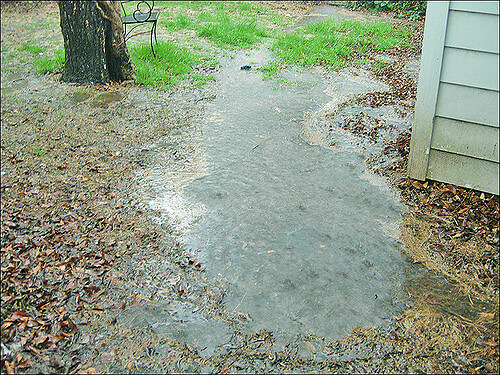
Do not run uphill chasing puddles. Instead, start at the outlet and work backward, forcing yourself to keep the required fall. If you find yourself fighting grade, change tactics. Sometimes the answer is a shallow surface swale, subtle but real, that nudges water two or three metres toward the French drain. A rake, a string line, and a little patience can set a swale too gentle to notice from the patio, but strong enough to feed the trench.
Around patios and walkways, align the drain along the downslope edge. Too often, I see a patio base built tight on clay. After a storm, the joint sand floats, then settles as the water evaporates. The perimeter French drain relieves hydrostatic pressure and keeps the base dry. For driveways that cross the path, use solid pipe through the load zone and transition back to perforated in stone beyond the wheel path.
Installation, step by step
- Strip sod and set string lines for slope. Move soil to a spoil area on tarps if the yard is tight, clay tracks everywhere.
- Excavate the trench to depth, 20 to 30 centimetres wide for small drains, up to 45 centimetres for major collection lines. Trim the bottom to a consistent fall.
- Line the trench with nonwoven geotextile, leaving enough width to wrap over the top of the stone later.
- Place a bed of clean 19 mm clear stone, set the pipe with perforations down or at 4 and 8 o’clock, then cover with more stone to near surface.
- Fold the fabric over the top of the stone and cap with topsoil or turf. At the outlet, stabilize with rip-rap or a pop-up emitter set in a small stone pad.
That list compresses years of muddy experience into a few lines. A couple of on-site points make a difference. Keep the trench walls neat and avoid smearing the clay. A smeared wall seals like pottery, which reduces lateral inflow. If you see glaze, rake or scuff the surface to reopen texture. Bed the pipe on stone, not on clay. A sag in clay is permanent. Take time to compact the backfill in lifts, especially under future lawn. You can always add more topsoil, but you will not enjoy mowing a sunken stripe.
What to do with sod, soil, and mess
Clay is unforgiving when wet. If you can, schedule the job for a drying window and protect the lawn. Lay down plywood runways for wheelbarrows or compact tractors. Keep spoil on tarps or in a bin. In tight city yards where access is limited, linear hand excavation remains practical, roughly 6 to 10 metres per crew-day depending on depth and obstacles. Homeowners who want to tackle part of the job themselves often handle sod cutting and initial layout, then bring in a pro for trenching and outlet work.
Sod rarely goes back perfectly. If the trench follows a long curve, I often strip sod in squares, then re-lay them across the trench like shingles to hide the seam. Water them well and expect a faint line for a couple of weeks, then it blends. If the lawn is already thin, use seed or a small roll of sod to finish. Clay compaction under foot traffic can undo your drainage gains. Before finishing, loosen the top 10 centimetres of surrounding soil with a broadfork or a core aerator, then topdress lightly with compost.
French drains and foundations: where to keep your distance
I see many DIY sketches with a French drain right against the foundation. Outside the footing zone, that can be fine, but know your intent. If your goal is to dry a yard, keep the drain at least 1.5 to 2 metres wet basement london ontario away from the foundation and slope the trench slightly away from the house. If you tuck it tight to the wall, you are creating a surface-level weep that can channel water downward, which is not what you want.
If you already have basement moisture and you suspect failed weeping tiles, the right search is weeping tiles London Ontario, not a yard French drain. Foundation drains need either exterior excavation down to the footing with new tile tied to a sump, or an interior weeper with a dimpled membrane and a sump. A yard French drain can complement that system by keeping bulk water away, but it will not fix a broken tile at the footing.
Costs you can expect in London
Prices vary with access, length, and discharge, but over the past few seasons typical numbers have settled into predictable ranges. For a straightforward backyard run of 20 to 25 metres with a gravity outlet, most homeowners spend 3,000 to 6,500 CAD. Add a curb cut or a new dry well, and you might see 5,500 to 9,500 CAD. An exterior sump with an electrical connection and a solid discharge line to the front can add 2,000 to 4,000 CAD. If access is tight and everything is hand-dug, labour hours rise and estimates follow.
Material splits look like this: pipe and fittings are the minor share, 10 to 15 percent, fabric and stone about 20 to 30 percent, and labour and restoration the rest. If someone offers a rock-bottom price that is half the market rate, ask where they plan to discharge, what fabric they are using, and how they will protect your lawn. In clay, shortcuts hide for a season, then they show.
Freeze, thaw, and spring performance
Will a French drain freeze? In deep cold, shallow sections can. Most of the time, the system still works in winter when the trench sits under snow cover and the soil stays insulated. The real test comes in late winter when a thaw sends meltwater across still-frozen subsoil. That is when you want a drain that is not choked with fines. Clean stone wrapped in fabric shines here. If your outlet is a pop-up in turf, keep it a few centimetres proud and on a small gravel pad so ice does not cement it shut. If it ties into a curb, check that the curb cut stays clear of ice.
In spring, expect a week or two of soft ground. Avoid driving on the trench line until the soil firms. If you see settling, top up depressions with screened topsoil. If you used clear stone to within 5 to 10 centimetres of the surface, the soil layer above can be light, and a dog or a child jumping repeatedly in one spot may dent it. That is easy to fix early and harder to fix after the lawn thickens.
Maintenance over years, not months
A well built French drain in London clay should run for 15 to 25 years with little attention. The failure modes I see share common roots. Someone skipped the fabric and fines migrated in. The perforations faced up and collected silt. The outlet clogged with turf roots. Or the pipe just did not have the fall to self clean.
Once or twice a year, check the outlet after heavy rain. If it is sluggish, flush the line with a garden hose from a cleanout near the high end. If the system lacks a cleanout, you can add one by cutting in a tee with a small riser hidden in a garden bed. Keep the first metre around the outlet mostly free of thick turf or invasive roots. Tree roots are less of a worry in clay because they dislike saturated zones, but they can still colonize a drain that constantly holds water.
Integrating with the rest of the landscape
A French drain is not a bandage, it is part of a hydrology. Once the drain lowers the water table in a trouble spot, the soil opens and accepts amendment. That is your chance to reshape the surface with subtlety. A millimetre per centimetre of fall in a swale is barely perceptible to the eye but moves water. Blend in a rain garden where the graded flow slows before it reaches the drain. Native plants like blue flag iris and Joe Pye weed tolerate wet feet and then thrive as things dry slightly.
Hardscape edges deserve new thought too. If you are renewing a patio, consider a permeable base. In clay, fully permeable pavers perform erratically because the subgrade does not infiltrate fast. A hybrid approach often works better. Keep joints tight and direct surface water to a narrow stone strip that feeds the drain below. That gives you resilience in a downpour without asking the entire patio to infiltrate.
Choosing help when you need it
Many homeowners tackle parts of a French drain. Trenching and managing discharge to a legal point, however, argue for experience. If you search french drains London Ontario or drainage contractors London Ontario, look for crews who talk about slope, fabric weight, and outlet details without skipping a beat. Ask for two or three recent addresses in your part of town and go look after a rain. A system that is a year old tells you more than any photo.
Permits and municipal rules can enter the picture when you touch the curb or sidewalk, or when you propose to tie into a storm lead. In some London wards, tying into the storm system is not allowed without a permit or inspection. Good contractors navigate that and will not suggest a connection that might later be capped by the city.
If either your goal or your budget favours a DIY route, consider a hybrid. Hire an excavator for a day to cut the trench while you prepare and restore. Use rented laser levels, not eyeballs, for slope. Buy fabric from a landscape supplier, not a big-box roll that tears under load. Save your energy for accurate layout and careful backfill. Clay punishes impatience.
A real yard, real clay, and a worked plan
A couple in Byron called after two summers of sogginess around a cedar deck. The lot sloped gently toward the back fence, then stalled at a flat swale shared by three properties. Every storm left water sitting under the deck and creeping toward the basement window well. Downspouts were extended, but the clay refused to absorb.
We sketched two options. One, a long narrow French drain along the back edge, tying into a daylit outlet near a side hill. Two, a shorter drain paired with a shallow surface swale cut into the turf that directed water to a small dry well. A laser told us there was not enough fall to daylight cleanly without building up the outlet significantly, which the homeowners disliked. We chose the hybrid.
We cut a 30 centimetre deep, 30 centimetre wide trench parallel to the back fence, 16 metres long, at 1.25 percent fall to a dry well lined with fabric and filled with 2 cubic metres of clear stone. We left 15 centimetres of soil cover above the trench, enough to carry lawn traffic. A 2 metre wide, 5 centimetre deep swale, shaped gently with a landscaping rake and checked with the level, fed the trench. The sump discharge was re-routed to the same dry well with solid pipe, only used during basements pumps. The first storm after the work put 25 millimetres of rain down in an hour. The swale carried a whisper of water, the dry well filled and then drained over six hours, and the deck joists dry stayed dry.
That yard taught nothing new, but it reinforced truths. Clay demands a place for water to go. Slope deserves measurement, not guessing. French drains deliver when matched to a discharge that respects the soil’s limits.
Tying it back to your lawn
If you wrestle with sloppy turf, a persistent marsh under the swing set, or a patio that never dries, you have options. Reroute downspouts, shape gentle swales, and where clay’s stubbornness beats those efforts, install a French drain with intent. When homeowners ask about french drains, they are not buying a commodity. They are building a path out for water that has been penned in by geology and grading.
Searches for backyard drainage London Ontario or weeping tiles London Ontario lead to a thicket of terms and promises. Keep your focus on the fundamentals. You need a trench that accepts water, a pipe that carries it, and an outlet that releases it legally and reliably. Everything else is judgement and craft.
If you want a second set of eyes, do not hesitate to bring in experienced drainage contractors London Ontario. A walk-through with a builder who has fought this clay pays for itself in avoided mistakes. And when the next big storm rolls through and your yard sheds water instead of hoarding it, you will know the difference that planning and a well built French drain can make.
Ashworth Drainage — Business Info (NAP)
Name: Ashworth DrainageAddress: 514 Hale St, London, ON N5W 1G8
Phone: (519) 660-9375
Website: https://www.ashworthdrainage.ca/
Email: [email protected]
Hours:
Monday: 9:00 AM – 5:00 PM
Tuesday: 9:00 AM – 5:00 PM
Wednesday: 9:00 AM – 5:00 PM
Thursday: 9:00 AM – 5:00 PM
Friday: 9:00 AM – 5:00 PM
Saturday: Closed
Sunday: Closed
Open-location code (Plus Code): XRR3+HV London, Ontario
Map/listing URL: https://maps.app.goo.gl/9kaoXAxRtJRP1ThS9
Embed iframe:
Socials (canonical https URLs):
Facebook: https://www.facebook.com/ashworthdrainage/
X: https://twitter.com/ashworthrules
Instagram: https://www.instagram.com/ashworthdrainage/
https://www.ashworthdrainage.ca/
Ashworth Drainage provides basement waterproofing and foundation repair services in London, Ontario and surrounding areas in Southwestern Ontario.
The company helps homeowners address wet basements, water intrusion, and drainage issues with solutions that fit the property’s conditions.
Service requests can include foundation repair, waterproofing options, sump pump and drainage-related work, and related assessments.
Ashworth Drainage is based at 514 Hale St, London, ON N5W 1G8.
To reach the team, call (519) 660-9375 or email [email protected].
Business hours are Monday to Friday 9:00 AM–5:00 PM, with the office closed Saturday and Sunday.
For directions and listing details, use the map listing: https://maps.app.goo.gl/9kaoXAxRtJRP1ThS9.
Popular Questions About Ashworth Drainage
What does basement waterproofing help prevent?Basement waterproofing is intended to reduce water intrusion and moisture problems that can lead to dampness, leaks, odors, and damage over time.
How do I know if I may need foundation repair?
Common signs can include visible cracks, water seepage, shifting or uneven areas, or recurring moisture problems; an on-site assessment is usually the best way to confirm causes and options.
What areas does Ashworth Drainage serve?
Ashworth Drainage serves London, Ontario and surrounding areas in Southwestern Ontario.
What are Ashworth Drainage’s hours?
Monday–Friday 9:00 AM–5:00 PM; Saturday closed; Sunday closed.
How can I contact Ashworth Drainage?
Phone: +1-519-660-9375
Email: [email protected]
Website: https://www.ashworthdrainage.ca/
Map: https://maps.app.goo.gl/9kaoXAxRtJRP1ThS9
Facebook: https://www.facebook.com/ashworthdrainage/
X: https://twitter.com/ashworthrules
Instagram: https://www.instagram.com/ashworthdrainage/
Landmarks Near London, ON
1) Kiwanis Park2) Western Fair District
3) Covent Garden Market
4) Victoria Park
5) Budweiser Gardens
6) Museum London
7) Fanshawe Conservation Area