DIY or Pro? Choosing Drainage Contractors for Backyard Drainage in London, Ontario
Backyard drainage looks simple until water starts pooling near your foundation, the lawn turns spongy, and spring thaw brings that sour smell of anaerobic soil. In London, Ontario, we live with thick clay, wide freeze-thaw swings, and heavy rain events packed into short windows. Those conditions punish sloppy grading and underbuilt drainage. The question that often follows a wet basement or a soggy yard is whether to take it on yourself or call drainage contractors in London, Ontario. The right answer depends less on bravado and more on soil, slope, and where the water wants to go.
I have worked on properties in the city from Old North to Westmount and out into the county. Some jobs begged for a shovel and a weekend. Others were only going to behave after a mini excavator, a transit level, and a crew that knows how clay behaves under load. What follows is a practical way to size up your situation, with specific notes for our local climate and norms, so you can decide whether DIY makes sense or whether french drains or weeping tiles should be left to professionals.
How London’s soil and climate shape your options
Glacial till under London makes for poor infiltration. Many neighborhoods sit on heavy clay that seals up after one or two rains. Sandier pockets exist along river corridors and in some newer subdivisions where imported fills were used, but clay dominates. That means water seeks the path of least resistance on the surface or along trench lines, not straight down.
Our frost depth runs roughly 1.0 to 1.2 metres, depending on exposure. That matters for pipe placement and for timing the work. Late spring through early fall is the least risky window, because open trenches and saturated clay do not mix well during freeze-thaw cycles. Snowmelt in March and April often overloads downspouts and sump discharges at the same time that the ground is still frozen near the surface. A system that works in July can fail in April if it relies solely on infiltration.
The City of London generally prefers downspouts to discharge on the surface, not into storm sewers, unless there is an approved connection. Newer builds come with a lot grading plan that must be preserved. Older homes often have legacy connections, and some have weeping tiles that daylit to the yard or connect to a sump. Those details affect what you can do legally and what will actually solve the problem.
What a good backyard drainage plan tries to do
A backyard drainage plan should move water away from the foundation and off the property at a controlled rate without pushing the problem onto a neighbour. In practice, that can involve:
- Re-establishing surface grading so that the top 3 to 5 metres next to the house shed at least 2 percent, about 20 to 25 millimetres per metre of run. Small grade changes do big work if they are continuous.
- Capturing concentrated flows from downspouts, sump discharge, or slope breaks, then sending them through solid pipe to a safe outlet, often the front ditch, a rear swale, or a city-approved storm connection.
- In clay-heavy yards where infiltration is poor, using shallow french drains sparingly and with realistic expectations. A french drain in clay mostly collects and conveys water, it rarely soaks it away fast.
- Protecting the foundation drainage system, often called weeping tiles in London, Ontario, so it does not carry roof water that should stay on the surface. Overloading weeping tiles accelerates failure and invites basement leaks.
The work looks basic on paper. On site, slight errors in slope create dead spots, and clay depressions hold puddles stubbornly. That is why measuring and verifying as you go beats eyeballing.
When DIY makes sense
If you can grade with a rake and a long straightedge, or run a shallow trench with consistent slope, you can tackle parts of backyard drainage in London, Ontario without hiring a crew. I have seen homeowners in Byron and Oakridge tidy up persistent puddles by adding two cubic yards of screened topsoil, resetting a couple of paving stones, and extending downspouts across the first few metres with solid pipe. No geotextile, no big spend, just better surface flow.
DIY shines when the problems are simple, contained, and visible. Think ponding in a low spot well away from the house, or a downspout that dumps against a porch slab. It can also work when you have a clear outlet within your property line, like a rear swale that already carries your neighbour’s runoff, as long as you keep your discharge gentle and protected with rock to prevent erosion.
Where DIY falters is depth, precision, and unknowns. Once you dig near utilities, foundations, or property lines, issues multiply. Corrugated pipe laid with uneven slope creates bellies that hold water and freeze solid. Trenching through compacted clay can destabilize a fence line if you do not manage spoils and backfill correctly. An incorrectly installed french drain might help for one season, then clog with fines because the wrong fabric was used or the stone was too dirty.
The case for hiring drainage contractors in London, Ontario
Good contractors navigate more than trench lines. They handle locates, grading design that respects existing lot drainage, and coordination if your plan touches city assets. They also bring tools you probably do not own, like a laser level, a plate compactor that can densify clay lifts without pumping, and a small excavator for tight yards. That combination saves time, but more importantly, delivers predictability. In clay, getting it right the first time matters.
There is also liability. If water from your yard damages a neighbour’s property because you redirected flow, you could be responsible. Reputable contractors document pre-existing site grades and provide drawings or hand sketches that show how the system will work. They know local practices, such as routing sump discharge to a splash pad and then a surface swale, or using solid SDR pipe for long runs under vehicle loads.
Expect them to talk through trade-offs. A shallow surface swale might be cheaper and more reliable than a deep french drain that tries to infiltrate into clay. If they recommend replacing or tying into existing weeping tiles in London, Ontario, they should explain how that affects your basement, not just your lawn.
Cost ranges you can use for planning
Numbers vary by access and finish quality, but realistic ranges help decision-making:
- Extending and burying downspouts with solid pipe to a safe surface outlet: 600 to 2,000 CAD per downspout run in typical yards. Longer runs that cross driveways or patios cost more.
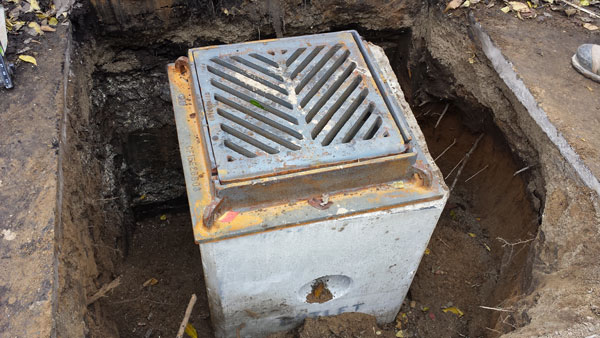
- Installing a basic catch basin with a 100 mm solid outlet to a swale or curb: 2,000 to 4,500 CAD, including restoration.
- French drains in London, Ontario for yard collection, not infiltration: 40 to 120 CAD per linear foot installed, depending on depth, stone quantity, and whether sod or hardscape needs reinstatement. DIY materials often land between 12 and 25 CAD per foot using 19 mm clear stone, quality fabric, and perforated pipe.
- Sump pump installation or replacement with proper exterior discharge routing: 2,000 to 5,000 CAD. Ties into storm sewers require approvals and can add significantly.
- Full foundation drainage replacement, the classic weeping tiles in London, Ontario: 8,000 to 25,000 CAD, sometimes more for deep foundations, walkouts, or complex landscaping. This is not a backyard tidy-up, it is a structural water management job.
Use these ranges as a filter. If your fix pencils out under 1,000 CAD in materials and a long weekend of labour, DIY may be rational. If the scope reaches into the thousands and touches the foundation or property boundaries, start interviewing contractors.
Permits, approvals, and the utility locate you cannot skip
Before any digging, book a locate through Ontario One Call. It is free, and most markings arrive within a few business days. Gas lines, hydro, telecom, and sometimes municipal services are not always where you expect. Striking a service line is dangerous and expensive.
For surface grading changes that alter the direction of flow, check the City of London’s lot grading guidelines. Newer properties have a grading certificate that must be preserved, and altering swales that serve more than one lot can create compliance issues. Discharging sump water or roof runoff to the street is often allowed if managed, but direct connections to storm sewers need authorization. If your home backs onto a conservation area or regulated watercourse, the Upper Thames River Conservation Authority may have additional rules. A contractor with local experience will flag these constraints early.
What makes a french drain work here, and when it will not
French drains have a stable place in the backyard drainage toolbox, but in our clay they perform best as collectors that move water to daylight, not as soakaways that promise quick infiltration. The anatomy matters. I like a 150 to 200 mm perforated pipe, rigid if possible for stable slope, set in a trench at least two pipe diameters below finish grade. The trench gets lined with a nonwoven geotextile that passes water, not the thin plastic weed barrier that chokes over time. The pipe sits on a bed of 19 mm clear stone. Then more clear stone, up to 100 to 150 mm above the pipe crown. Fold the fabric over the top, add a thin layer of washed sand if needed, then soil and sod. For long runs, add cleanouts that you can camera or flush.
Depth is not about hitting a magic layer. It is about keeping the system above frost where possible and sloped consistently at about 1 percent, with 0.5 percent as the practical minimum. In clay yards, perforations should face down if using rigid pipe with defined holes, and the trench should avoid crossing tree root zones whenever possible. Expect to daylit the outlet to a swale, rock pit with overflow to grade, or a permitted municipal tie-in. A blind end in clay is just a wet sponge.
Homeowners often ask about fabric choices. Nonwoven needle-punched fabrics in the 4 to 8 oz range typically suit clear stone and clay interfaces. Woven fabrics are strong but can restrict flow rates and are harder to conform in tight trenches. Cheap landscape fabric will clog. You will not see it right away, but it happens.
Weeping tiles: what they do and why they are not a catch-all
Weeping tiles are the perforated foundation drains that sit at or below footing level. In London, many older homes still have the original clay tile or early plastic variants. They are designed to collect groundwater around the foundation and send it to a sump or storm outlet. They are not meant to accept roof downspout water or yard drainage except in older systems where everything was tied together. Connecting yard drains into weeping tiles increases hydrostatic pressure at the wall, which is the opposite of what you want during a big storm.
If your basement is damp or your sump runs constantly after light rain, consider having the weeping tiles inspected by camera. Replacing them is a major project with excavation to footing depth and is not a DIY candidate for most people. If a contractor suggests tying your backyard french drains into the weeping tiles in London, Ontario to save trenching, ask them to explain how they will prevent surcharge at the wall. Good contractors will not merge those systems casually.
A simple decision filter you can use
Here is a quick way to decide whether to go DIY or hire:
- The water problem is more than 3 metres from the foundation and can be solved by surface grading or a shallow collector with a short run to a clear outlet, consider DIY.
- You plan to alter swales that serve multiple lots, or water flows toward a neighbour’s house, hire a pro.
- You need to dig deeper than 450 mm, cross utilities, or work near the foundation, hire a pro.
- You cannot maintain at least 0.5 percent slope to a safe outlet without cutting through hardscape or tree roots, hire a pro.
- You are comfortable with compaction, fabric selection, and verifying slope with a level, and the fix costs under about 1,000 CAD in materials, DIY can be smart.
How a professional crew tackles a backyard drainage job
On a typical backyard drainage London, Ontario project with clay soils and a chronic puddle near the patio, a seasoned crew will start with water paths. They shoot elevations with a laser to confirm fall from house to swale. If the grade is marginal, they design a shallow swale that blends with the lawn, then pair it with a solid 100 mm line that picks up the worst roof loads from downspouts. Where the patio edge has heaved, they may lift and re-lay a strip, adding granular base to preserve the new flow lines.
Trenching goes quickly with the right bucket and a plan for spoils. Clay spoils cannot always be reused at the surface because they seal. Good crews bring screened topsoil for the top 150 mm and compact clay backfill in controlled lifts below. Sediment control keeps dirty water off the sidewalk and out of neighbours’ yards. It is not just courtesy, it protects the work from washing out.
Rock choice and fabric are not afterthoughts. Clean 19 mm clear stone comes from a reputable pit, not whatever is cheapest that week. Dirty stone clogs fabric. The perforated sections have enough fall to shed water even after a small settlement over the first season. Cleanouts are placed where a garden bed can hide them, not in the middle of the lawn where a mower will clip them.
At the outlet, crews build a small dissipater with river rock, not pea gravel, so that energy drops and turf does not scour. If there is no natural outlet, they propose a shallow dispersion trench with overflow to a defined low point, and they set homeowner expectations realistically about performance in big storms. They finish by restoring sod or seed, then scheduling a check after a few rains. Attention after the first storm separates pros from fly-by-night operators.
What a careful DIY install looks like
If you decide to build a small french drain yourself to address backyard drainage in London, Ontario, keep it simple and verifiable.
- Call Ontario One Call and wait for marks. Confirm depth clearances before any digging.
- Stake your start and end elevations, then run a string line or use a long level to verify at least 0.5 percent fall. Check every 2 to 3 metres as you dig.
- Use nonwoven geotextile to line the trench. Bed the perforated pipe in 19 mm clear stone, then cover with at least 100 mm more stone, and wrap the fabric over the top before backfilling.
- Keep perforated sections for collection zones, then transition to solid pipe to the outlet so you are not re-wetting the lawn along the run.
- Daylight the outlet with rock protection or a basin grate at a point that does not send water onto a neighbour’s lot.
Two small cautions. Do not substitute corrugated black pipe everywhere just because it is flexible. It is fine for short connections, but for longer runs where slope matters, use rigid PVC or SDR35 so bellies do not form. And do not backfill the last 150 mm with clay. Use screened topsoil so the surface breathes and the lawn recovers.
Pitfalls I see over and over
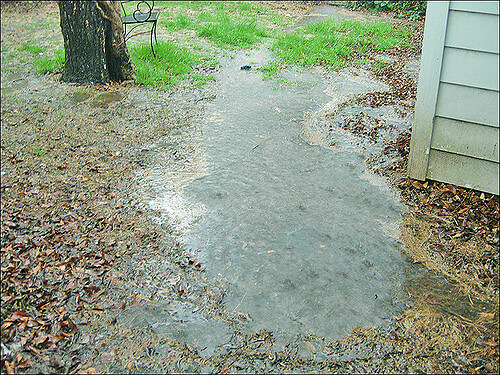
The first is thinking infiltration will solve everything. In our clay, trenches fill and stay full. If you do not give water a place to leave, you just delay the problem. The second is undersizing outlets. A tiny pop-up emitter buried in lawn thatch will not pass a thunderstorm’s worth of water, especially with grass clippings clogging the hinge. Third is neglecting surface grading because the drain looks cleaner. Swales are the simplest tool we have, and when they are gentle, they mow fine and function in winter when pipes freeze.
Another common mistake is tying all downspouts into one pipe that crosses low ground without cleanouts. When that single line silts or freezes, every roof plane unloads at the worst spot. Break loads into manageable sections. If you add a sump extension, terminate it on a splash pad that spreads flow before it reaches lawn, and route excess through a defined path so it does not tunnel under walkways.
Finally, people forget maintenance. Catch basin grates need clearing after leaf drops. Outlets should be checked after the first freeze-thaw cycles. Buried emitters should be flushed yearly. A 10 minute check in April prevents hours with a spade in June.
Evaluating drainage contractors London, Ontario without guesswork
You can gauge competence in a five minute conversation. Ask how they verify slope. If they say “by eye,” keep looking. Ask which geotextile they prefer for clay with 19 mm clear stone, and why. You want a specific answer, not “landscape fabric.” Ask what they do with spoils. If they plan to backfill the top layer with clay and pack it hard, they are sentencing your lawn to a hardpan. Ask how they handle locates, whether they carry liability insurance, and whether their plan alters any shared swales. A good crew will welcome those questions and often bring photos of past work in similar soils.
References matter more than low price. A drainage fix that fails quietly two seasons later costs more than the difference between quotes. I like to see at least one project that has lived through a winter and a spring. If a contractor has installed french drains in London, Ontario on multiple clay-heavy lots and can show you outcomes after big rains, that is worth a premium.
How I would approach three common backyard scenarios
A typical Old South lot with a slight inward slope toward the back porch: I would regrade the top 3 metres next to the house to re-establish a 2 percent fall, extend two downspouts with solid 100 mm pipe to a side yard swale, and add a small rock dissipater. No perforated pipe unless a specific low spot persists. Cost with a contractor might land around 3,000 to 6,000 CAD, depending on access and restoration. DIY could be 800 to 1,500 CAD in materials and a weekend of labour.
A newer Northwest London property with heavy clay and a stubborn puddle in the middle of the yard: I would cut a shallow swale that ties into the subdivision’s rear swale, then add a short french drain section with perforated pipe and clear stone under the low spot to collect perched water and send it via solid pipe to daylight at the swale. Expect 2,500 to 5,000 CAD professionally, or around 600 to 1,200 CAD for a careful DIY.
A ranch home with intermittent basement dampness and original weeping tiles: I would avoid any yard tie-ins to the foundation system. Start with camera inspection of the weeping tiles, verify sump discharge routing, and correct roof loads so they leave via surface routes. If the tiles are failing, that is a separate project. Mixing it with yard drainage saves nothing and risks a leak path.
The value of doing nothing, briefly
Sometimes the best move is to watch one more season. If you just bought, do not rip up the yard in May because of what you saw in April with frozen ground. Take notes through summer storms, then through fall leaf drop. Mark puddle edges with lawn flags so you can see patterns. Data helps you avoid oversizing or building the wrong system. Clay rewards patience.
Final thoughts grounded in local reality
Backyard drainage in London, Ontario lives https://telegra.ph/Wet-Basement-London-Ontario-When-to-Call-a-Professional-vs-DIY-05-20 at the intersection of soil physics, weather, and the rules of neighbours. Fixes that respect those three usually work. For simple issues, a homeowner with a shovel, a long level, and attention to detail can build an effective solution. For anything that touches foundations, shared swales, utilities, or deep trenches, drainage contractors in London, Ontario earn their keep. They understand how our clay reacts to excavation, how to shape swales that carry water without looking like ditches, and when french drains play a supporting role rather than starring.
If you take nothing else, remember these two principles. First, give water an honest path with measurable fall to a lawful outlet. Second, avoid feeding foundation systems with surface water. Build from there. Whether you go DIY or hire help, those principles will carry you through spring thaws, summer storms, and the long, wet shoulder seasons that test every yard in the city.
Ashworth Drainage — Business Info (NAP)
Name: Ashworth DrainageAddress: 514 Hale St, London, ON N5W 1G8
Phone: (519) 660-9375
Website: https://www.ashworthdrainage.ca/
Email: [email protected]
Hours:
Monday: 9:00 AM – 5:00 PM
Tuesday: 9:00 AM – 5:00 PM
Wednesday: 9:00 AM – 5:00 PM
Thursday: 9:00 AM – 5:00 PM
Friday: 9:00 AM – 5:00 PM
Saturday: Closed
Sunday: Closed
Open-location code (Plus Code): XRR3+HV London, Ontario
Map/listing URL: https://maps.app.goo.gl/9kaoXAxRtJRP1ThS9
Embed iframe:
Socials (canonical https URLs):
Facebook: https://www.facebook.com/ashworthdrainage/
X: https://twitter.com/ashworthrules
Instagram: https://www.instagram.com/ashworthdrainage/
https://www.ashworthdrainage.ca/
Ashworth Drainage provides basement waterproofing and foundation repair services in London, Ontario and surrounding areas in Southwestern Ontario.
The company helps homeowners address wet basements, water intrusion, and drainage issues with solutions that fit the property’s conditions.
Service requests can include foundation repair, waterproofing options, sump pump and drainage-related work, and related assessments.
Ashworth Drainage is based at 514 Hale St, London, ON N5W 1G8.
To reach the team, call (519) 660-9375 or email [email protected].
Business hours are Monday to Friday 9:00 AM–5:00 PM, with the office closed Saturday and Sunday.
For directions and listing details, use the map listing: https://maps.app.goo.gl/9kaoXAxRtJRP1ThS9.
Popular Questions About Ashworth Drainage
What does basement waterproofing help prevent?Basement waterproofing is intended to reduce water intrusion and moisture problems that can lead to dampness, leaks, odors, and damage over time.
How do I know if I may need foundation repair?
Common signs can include visible cracks, water seepage, shifting or uneven areas, or recurring moisture problems; an on-site assessment is usually the best way to confirm causes and options.
What areas does Ashworth Drainage serve?
Ashworth Drainage serves London, Ontario and surrounding areas in Southwestern Ontario.
What are Ashworth Drainage’s hours?
Monday–Friday 9:00 AM–5:00 PM; Saturday closed; Sunday closed.
How can I contact Ashworth Drainage?
Phone: +1-519-660-9375
Email: [email protected]
Website: https://www.ashworthdrainage.ca/
Map: https://maps.app.goo.gl/9kaoXAxRtJRP1ThS9
Facebook: https://www.facebook.com/ashworthdrainage/
X: https://twitter.com/ashworthrules
Instagram: https://www.instagram.com/ashworthdrainage/
Landmarks Near London, ON
1) Kiwanis Park2) Western Fair District
3) Covent Garden Market
4) Victoria Park
5) Budweiser Gardens
6) Museum London
7) Fanshawe Conservation Area